
Snowbird Season
The constant flurry of movement around the nursery is punctuated by the busy flitting of brownish-grey snowbirds, often seen as flashes of white as their tails and underbellies soar neatly from tree to shrub to feeder.
The snowbirds, technically called dark-eyed juncos, are heralds of true winter, and most commonly make hurried appearances around feeders during inclement (human) weather. Their specific epithet, hyemalis, literally means “of the winter”; believe it or not, a similar epithet can be found in the evergreen, prehistoric forb, Equisetum hyemale, or our common horsetail. Take that for what you will, but I can attest to horsetail’s winter hardiness after having seen it dutifully rise above icy creek waters with but a twinge of bronzing at its tips. That’s neither here nor there, though, because this week we’re talking about snowbirds.
Unlike the tufted titmice who prefer enjoying their meals in the comfort of their tree cavities, dark-eyed juncos will often be seen enjoying their bounty right at the feeder in groups, gravitating towards millet, cracked corn, and sunflower seeds.
Dark-eyed juncos are regular winter visitors and year-round residents in New Jersey and much of the Mid-Atlantic region, preferring open woodlands with coniferous trees and low shrubs. Snowbirds create cup-shaped nests on the ground hidden by shrubby vegetation and sometimes next to rocks to disguise their eggs, making groundcovers, grasses, woodland perennials, and suckering bushes critical to their wellbeing.
Snowbirds are adaptable, to say the least. They can be found across a vast majority of the North American continent, predominantly in cooler zones, and unlike other bird species may not migrate much, if at all. Remaining in trusted social groups, dark-eyed juncos are tough little birds that have no problem standing their ground even in some of the harshest conditions. Color variations may occur within a local population, with feathers ranging from slate gray to dusty brown, to a warm grey tinted with chestnut-reds and coffee-pinks.
At one point, due to the color variations among juncos, they were split into various subspecies… which as you can imagine, turned out to be a nightmare, resulting in the conclusion during the 1970s that they should all be classified under Junco hyemalis to make things a little easier. Interestingly, juncos have proven themselves to be quick evolvers, able to revolutionize themselves to whatever conditions they’re met with. During COVID-19, when human-produced food became less available, snowbirds were found to have quickly evolved to a “natural” beak state, or a slightly longer beak for gathering natural resources, rather than the shorter, blunt, light-pink beaks they’ve been accustomed to in order to properly navigate our gardens and cultivated landscapes (disclaimer: the link provided directs to a paywall article, so you need an NYTimes account to read it).
Their evolutionary successes have been particularly helpful in preparing snowbirds for virtually any and all circumstances that human beings or Mother Nature throw at them. Despite their tiny and seemingly meek size, fluffy appearance, and amiable demeanor, snowbirds are resistant to ice. Not only that, but they prevail over it altogether. Performing their ritualistic double-scratch-and-peck, they’re able to slowly chip away at the harsh, cold layer of resistance, gradually and determinedly scraping away at the icy facade in a tight-knit community of like-minded individuals. While it may appear to be a slow process, their efforts are prominent in the thick layer of ice: indelible marks on a false and fragile surface.
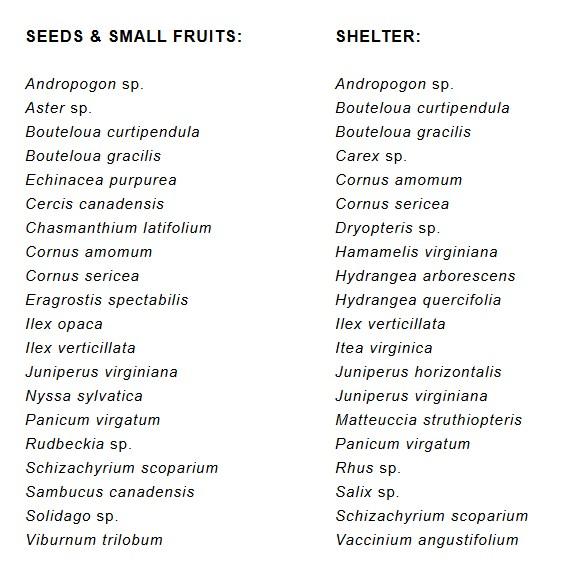
When they’re not diligently scratching away at the ground in search of insects and fallen seeds, snowbirds rely on a host of native plant species not only for food resources, but also for shelter. Seeds make up a majority of their diet year-round, with the occasional insect as a supplement to their spring and summer menus, and small berries and fruits on native trees and shrubs whenever available.
Below is a list of helpful plants that support dark-eyed juncos, although we highly recommend you encourage them to your feeders also. They are delightful companions, and a gentle reminder of the adaptability and hope that mother nature bestows upon us even in times of crisis.