
The Lowdown on Downies
I thought this week would be a fairly easy write up. After all, woodpeckers are fairly conspicuous birds. Namesake rhythmic drumming of tree materials aside, their undulating flight patterns and often flashy black-and-white plumage sprinkled with dashes of brilliant red (like the pileated woodie) and occasionally yellow and tawny brown (think Northern flickers) make them impossible to ignore as an avid outdoorsperson, especially one that tends to wander about open woodlands.
I’ve always had a fondness for woodpeckers, in part because of my admittedly woo-woo belief system that has nurtured a spiritual connection to the avian world (I know, I know, roll your eyes all you want). I’ve had a note in my phone for four years now that slowly accrues logins and passwords, footnoted with a passage about woodpeckers as spiritual guides, from a random website that seems now to only exist in the liminal space of the wayback machine. I’ve always chided myself as someone who knows her woodpeckers, big and small, all shapes and colors.
As it turns out, I couldn’t tell a downy woodpecker from the hole in the ground. Downy woodpeckers are the smallest of North American woodies, which you think would be a really good indicator when you’re out searching for one in the world. Well, hairy woodpeckers are spitting images of downy woodpeckers: only slightly larger, with only slightly different, less pronounced markings and a white “comma” on its shoulder, the only truly obvious characteristic being the longer, more robust beak.
Downy woodpeckers, with their smaller, blunter beaks, also have a tuft of fluffy bristles at the base of their beaks near their nostrils and have an overall “downier” appearance, hence their name. Both prefer open woodlands and tend towards more mature, even old-growth forests, have basically identical breeding and brood schedules, and devastatingly similar calls, leaving it up to the observer to suss out the differences. Beak size, if you’re close enough to reckon what you’re looking at, is one of the best comparables between the two. To put it morbidly, if you were to take the beaks of both the hairies and the downies and flip them 180° inside their skull, the downy’s beak would only go a little over halfway through its skull, while the hairy woodpecker’s beak would fully penetrate the back of its skull. Woodpecker brutality aside, it’s a poignant way to tell them apart.
Downy woodpeckers are voracious feeders of Coleopteran species, especially those that tend to be problematic in the horticulture industry. While dead trees are preferred for excavating nest cavities and are a typical feeding ground for hungry downies, live trees suffering from pest infestations are the equivalent of a bird buffet. Their beak size is perfect for getting into bark, small branches and stems <1” diameter – the entry points for any and all boring insects. Bronze birch borers, emerald ash borers, peachtree borer caterpillars, maple borers and spongy moths are all fair game for downy woodpeckers, who also enjoy ants as a light snack. During fall and winter when insect populations begin to decline, downy woodpeckers turn to their other favorite pastime: opening the goldenrod galls left behind by Solidago-specific gall wasps to get to the gooey goodness inside. If you’re lucky and live close to an open woodland, you may have one visit your feeder in winter, otherwise they tend to forage for local small fruits and seeds, sumac berries and grains being particular favorites.
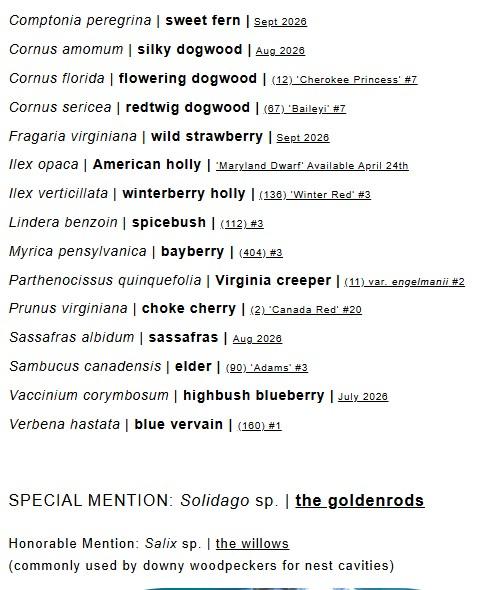
Below are fruit and seed-producing plants that are preferred by downy woodpeckers, although it should not be ignored that Solidago species are critical for supporting these birds via the specific goldenrod gall wasps that rely on them.